
There are many beings which could be considered gods. So any decent scholar must choose a metric by which the scholar will divide the beings into their categories. What makes something an angel or a demon rather than a god? How shall we judge. The definition of god is tied to a simple question. Does the being in question demand worship? If it does, then it is a god. And if it is a god then, because it needs worship, it cannot be trusted.
The Bankers of Vajra and Souls
Gods are composite beings. Incorporeal as Spirits, derived from concepts as Elders, and bearing anthropomorphic avatars as Fair Folk; Gods have one unifying factor. Gods require human belief, human prayer, sacrifice and offerings. Gods are empty vessels that cannot generate any power of their own. They are bankers or insurance brokers, absorbing the Vajra and Souls offered them from a multitude of worshipers and giving back some small measure to the occasional worshiper as a miracle.
Gods can be a source of great power, but the cost is high. And it is difficult for a Freepath Sorcerer to use the power of the gods without breaking the first of the four great laws and worshiping that god.
There are no living Gods. All gods are dead Gods, because all gods are murdered elders and murdered spirits. Hence the tribe will see the transition for animism to polytheism as a degeneration, a first step on the slippery slope towards the way of the Locust
About Gods
Weaver gives an Introductory Lecture
Where do the Gods live? I’m asking this for no reason. This is a tremendously important question.
The gods live on Olympus, in Asgard, in Heaven, in the Underworld, on R’lyeh, in other dimensions, in higher planes of existence. Why? What is the common feature? What does this tell us?
The gods live in conceptual space. They live in stories. Gods and devils are like the phoenix: they rise from their own ashes as each new person tells and retells their story.
Am I saying gods are false? No. Am I saying gods are not real? No. Am I saying that gods are fictional? Yes. They are creatures of the story and they live only within story and only so long as the story continues to be internalized and retold. Many people you tell this too will make the mistake of thinking that I am saying that gods are nothing, or are powerless or are false. I am saying nothing of the sort.
Look at the triplets known as God the Father, Allah and Yahweh. Such a strange trio. I knew them when they were one God. Between that Abrahamic Trinity, that three in one, you can count power to reshape the globe. The Gods of Old Egypt raised the Great Pyramids.
Gods are ideas, and ideas are tremendously powerful. They possess the mind and compel the body.
Or as another prophet of a false god said, speaking through his own fictional homunculi, “Beneath this mask there is more than flesh. Beneath this mask there is an idea, Mr. Creedy, and ideas are bulletproof.”
I know that this would seem to be a dismissal of miracles, but don’t tell me that spread of the words of a Jewish Carpenter’s little doomsday cult after the execution of its founder was anything less than miraculous. Don’t tell me that all the amazing things religious people have accomplished inspired by, compelled by and in the name of their religions are less than miraculous.
Religion uses the most powerful social and psychological technologies ever discovered to achieve shocking, awe inspiring and terrifying feats of nearly all descriptions. And those who control the bureaucracies that arose around religion have sought to keep the realm of the gods hidden so that nobody else may learn the techniques and draw upon the power of the gods save as sanctioned by the bureaucrats. The bureaucrat priest is in fact the prison guard who has jailed the god and uses that god as a draft animal to do heavy lifting on behalf of the priest.
So this is my aim, little mortal. I will free my brethren. I will secure my immortality. And I will empower the storytellers who make gods possible.
But first, we must become familiar with the realm of the gods: the Shadowlands.
Beings of Sky
Gods are beings of the Sky, above all that is flesh and earth. When Gods manifest, they do not touch the ground. Gods are associated with the sky because they spawn out of the Realms of the Afterlife, which are visible in the skies of the Major Realms. Gods who have attracted enough worshippers are able to form a throne, which dramatically enhances their power. The Locust King has captured the Thrones of the Dead gods of the city of glass through use of the power given to him by the Gray Locust. Thus the Dead Gods of the City of Glass are dramatically weakened, and enslaved to the Locust King. And the Locust King is able to use their Thrones to enhance his own power. Once powerful enough, Gods gain an aura with which the gods May drain vajra from those too close to the being.
There is an earth Sky dichotomy in this heartlands mythology of the free peoples with the Earth being the positive Association and the sky negative. Lighnting is a an omen of danger in the Shadowlands. Menstrual blood is regarded as Sacred by the Earth and can be used as a valuable barter item with demons. However it can be used to drive off, vine, or burn gods or their holy servants
Ur Gods
Legion

Gods are born and powered by belief. And at the core of this power is the belief IN gods. To believe in a single god, one must first believe in the concept of Gods. Legion, the one who is many, is the personification of that idea of Gods. A Primordial being of contradiction and confusion, Legion is the source of all other gods. No mother or father, but the single celled precursor to the Gods that men worship by name. It feeds off the unacknowledged faith in faith, and belief in belief and belief in the idea of Gods.
A powerful but insane scavenger and bottom dweller, even the most noble appearing of Gods is descended from this elder monstrosity.
Legion dwells in the Hidden Heart, and psychonauts who manage to find their way to that hidden realm are advised to be wary of this thing of pre-thinking belief.
The Nameless Gods
Before Gods took names they existed at the edge of understanding, In the early days of culture and language, as animism shifted to worship, Gods were not always named. Some of these nameless things retain enough worship to still exist today, and psychonauts are warned not to speak to reverently or make statements appearing too much like generic prayer. Stray words can provoke a nameless god to answer an unattributed prayer and then demand payment.
Every now and then, a Nameless God will acquire a voluntary worshiper or even a cult. And even more rarely a Nameless God will acquire a name and enter the ranks of the Named Gods.
Learn more about the Ur Gods.
Named Gods
The Starving Gods
Because of the Locust King and the HUngry Empire, people are always dying of starvation. The bones of these dead, human and otherwise, sink into the earth and drip through the layers that separate the other realms until they reach the Painted Labyrinth.
Here in the darkest parts of the Painted labyrinth exist the ancient Primordial gods. Preceded in the history of Godly Evolution by the Nameless Gods and Legion itself, these ancient gods have lost their conscious followers, but are unable to die because they are so primal in their personae that most people are unable to completely disbelieve in their existence. As such they steal what scraps of offerings they can from the corpses of those who have died of starvation- making prayers in vain to anything that will listen.
Should a Psychonaut stumble onto the altar of one of these vicious prehistoric Gods, they will attempt to enslave or consume the Psychonaut, frequently forming a vaguely human skeletal body from the masses of bones that have dripped like melted wax into their lairs.
Defeating or confounding the Starving Gods may put them in a bargaining mood, but psychonauts should be warned of the dangers of attempting to appease a being a desparate as one that is starving but unable to truly die.
Learn more about the Starving Gods.
Pantheons
The Gods of Light
Living in the Realms of the Afterlife and treating death as an eternal sentence of servitude for those beings foolish enough to die beholden to one of more Gods, the Gods of Light seem the most benevolent on the surface.
Hierarchy of the Gods of Light
The Tetrarch Lords: the rulers of the Realms of light, these four Courts of Gods share the rule of the Realms of light- and do so with much conflict and internal strife. The Ruler of each Court is the Father, with the Son the active lieutenant and Heir Apparent. The Grandfather serves as Advisor and frequently attempts to be the power behind the Throne.
Archons: The Highest of the Lesser Gods of Light, Archons could be though of as the nobility- Dukes and Barons and Counts and so on.
Angels are the least of the Gods of light and are frequently mistaken for something other than Gods. But Gods they are, and they yearn for greater power than they have. Scheming and plotting and rebellious, angels are power hungry messengers and foot soldiers.
In truth, there is always a rebellion in heaven.
Archons and Angels look like a glorious and monstrous mix of insect and machine. wheels and wires, carapace and compound eyes, built upon the bodies of internal combustion engines and clockwork halos. surrounded by dragonfly wings arranged in parody of the feathers of great birds of prey with inverted masks of human faces somewhere near where a head should sit. Frequently a Television screen or another sort of monitor is visible on the Angel’s body and will provide a means of communication and display the emotion that they expressionless mask cannot.
- Typical Angels are blank faced golden conntructs with insect wings made of light (Malakim?)
- Also drone surveillance! Minor Angels (Tceribim?), more insectile and robot like with blank faced masks.
Souls are the Inhabitants of the Realms of the Afterlife. Beings who pledged their souls to Gods of Light find that their souls end up in the Realms of the Afterlife upon the death of the individual- this applies to the Souls of Psychonauts should their aura shatter in the Shadowlands as well- if they have made deals where their soul was pledged. All souls are grey, and where smiling masks. They act out stepford wives style traditional values lifestyles and if challenged or scolded, they cry bloody tears.
Deals with the Gods of Light
An avatar who deals with a god and fail to avoid a soul pledge will lose all their avatar progress should their aura be shattered. Their soul will become one of those in one of the Heavens, mask and all. Retrieving a soul from the realms of light is like retrieving a blood stain in Dark Souls, like Orpheus’ journey to the Underworld. Psychonauts must quest to the appropriate Afterlife and retrieve the soul or start all over again with the first Ring Excursion and the unlocking Excursions in the Foglands.
Learn more about the Gods of the Realm of Smoke.
Learn more about the Gods of the Realm of Fire.
Learn more about the Gods of the Realm of Thunder.
Learn more about the Gods of the Realm of Lightning.
The Dead Gods
Technically all gods are dead gods, but one group in particular is known by that as a title: The Dead Gods, so named because they have managed the difficult task of dying twice. The Dead Gods are the Gods captures and bound to the Hungry Empire. These Gods are chained to the Wards of the Mirrored City. Unlike the Gods of Light, who serve the Hungry Empire for their own benefit, the Dead Gods have been enslaved to the Hungry Empire against their will.
The Pantheon of the Dead Gods is a collection of captured deities from other pantheons. Their names and histories have been stripped from them, they are pale versions of themselves. But unlike the Gods of Light, the Dead Gods yearn for freedom.
Learn more about the Twice Dead Gods.
The Vu’Hath Blood Gods
The Gods of Rage. Now dead for all intents and purposes. The Locust King once used these gods to power his armies, but now relies more upon gods who can generate conformity. As such the Vu’Hath are not even enslaved as part of the City of Glass to empower the Locust King, but abandoned.
The Vu’Hath are symbolic of the fire that powered ancient armies, and as such -despite being Gods of Rage and War and Conquest- their Metaphors revolve around the trappings of agriculture, the burning of grasslands to clear the land for fields, irrigating fields and working the land, and both their symbols are offerings are cereal grains. An army marches on its stomach after all.
Learn more about the Vu’Hath Blood Gods.
The Gods of Dust

The Hungry Empire provides a feast for the few, and promises a feast for the many while supplying them with only scraps. in order to keep the many who are hungry from rebelling, the Locust King turns to the Gods of Dust who lionize deprivation and poverty and suffering as the path to righteousness. These gods are subtle and pernicious and have survived multiple dynasties of the False King, where many other Pantheons have been discarded as the Ten Thousand Years of Darkness march towards its inevitable end.
Learn more about the Gods of Dust.
The Gods of Death
All Gods are dead, but few gods embrace death to the degree these gods. They are not a true pantheon, but they have drifted together through shared association.
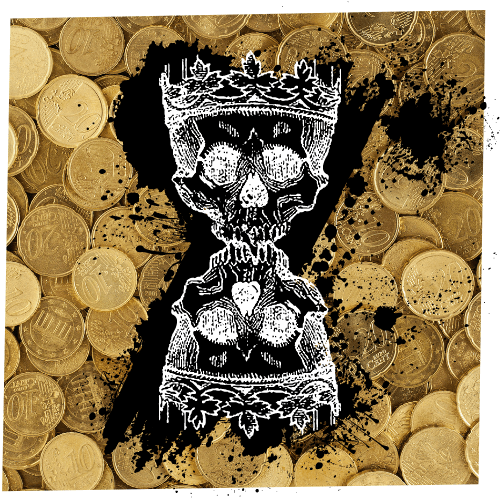
All Gods are dead, but few gods embrace death to the degree these gods. They are not a true pantheon, but they have drifted together through shared association. The power of the Gods of Death lies in their ability to ensnare the stories of those who have died. These Gods capture the stories as family and friends tell the tales of those now dead. If the stories are not bound back into the Weaver’s web properly, the Gods of Death (or worse, the Gods of the Afterlife) will capture the lost and wandering stories to add to their own power.
Some of the Gods of Death are more sympathetic to the fates of the stories they capture. Others amongst the Gods of Death simply use the stories as power to fuel their own goals.
Learn more about the Gods of Death.
 Professor Harbinger's School for Villains