
The Denizens of the Shadowlands are divided into three categories: Inhabitants, Archetypes, and Others. The Inhabitants are the minds inhabiting the Shadowlands. The Inhabitants provide the substrate upon which the rest of the Shadowlands grow. They are human and non-human, plant and fungus. They are mortals whose minds float in the Shadow Seas and from which bloom the major realms and all the other wonders of the depths. The Archetypes are the cloaks which inhabitants don to change the story or contribute to them. The Archetypes are timeless heroes, they are roles which the story needs in order to continue to tell its tales.
The Others are the apex predators of the shadow seas. They are the most powerful beings in the Shadow Seas, but unlike the inhabitants, they have no existence in the Bonelands. They cannot survive outside the Shadowlands, and indeed, they can only survive in the Shadowlands when the inhabitants create a substrate strong enough to support a proper narrative ecosystem. They are gods and demons, monster and spirits and eldritch abominations. And they can only live within our minds and within our stories.
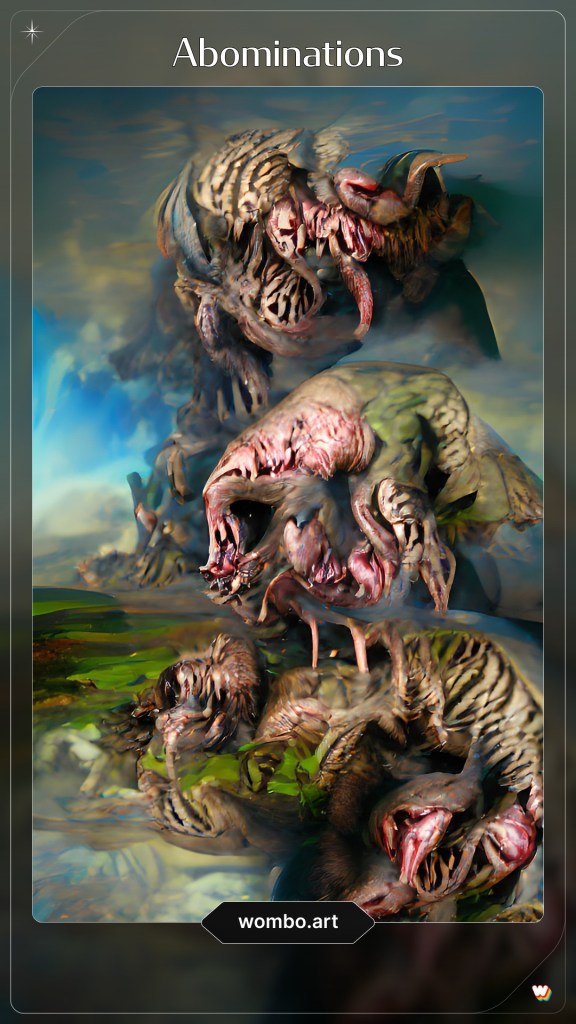
Yes, they live in our words and our minds. But like bacteria, they can have an enormous impact upon their hosts. The Others are necessary to the proper functioning of the sentient psyche. But not all Others are created equally. Elders are power and useful, but dangerous and must be handled with care. The Fair Folk and the Spirits are both helpful if dealt with safely. The Monsters are important to the strengthening of our minds. The Gods are toxic parasites which can damage our minds if our psychic immune system proves insufficient.
They are fiction. But not make the mistake of thinking that this means that they are not real. They are ideas, and nothing in more powerful than ideas.
The Others are also divided into several order: Spirits, Elders, Gods, Fair Folk, and Monsters.
“Children accept many things adults will not accept, since the world of a child is a constant revelation without any need for knowledge of cause and effect.”
August Derleth
All the denizens will assist Sorcerers in the Shadowlands, but all have a price. Elders demand stories. Spirits demand attention. Gods demand worship. Fair Folk (Demons) demand oaths. Monsters demand blood.

All of the Others run a balance between form and concept. Fair Folk, Gods, and Elders are all a mix of corporeal and incorporeal. The Monsters are nearly entirely corporeal. The Spirits are nearly entirely incorporeal. The Monsters are the puzzle of the flesh, beasts who are slaves to their form. The Fair Folk favor a physical form. But they are sufficiently incorporeal that if their current form is destroyed, they may easily form a new one. The Elders are primarily incorporeal. But they can form a physical form if required, but have little attachment to it. The Sleeper, for instance, infamously likes to borrow the form of others rather than form their own. The Spirits have only the barest whisper of a connection to physicality, the polar opposite of the Monsters.
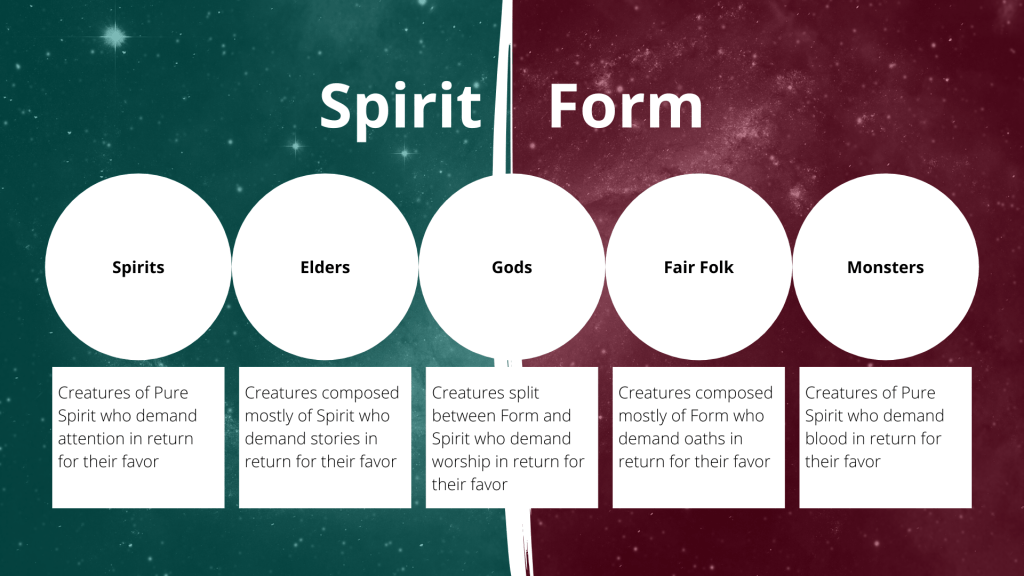
The Monsters are anchored to the the realms in which they live. Legend says that they once, long ago, sacrificed their incorporeal nature to build the major realms and anchor them to the Shallows. As the legends tell, the Fair Folk and the Elders likewise sacrificed some of their incorporeal nature, the Fair Folk more so than the Elders. The Gods supposedly saw this, and did likewise, but used their own nature to build the Realms of the Afterlife to benefit themselves rather than the inhabitants of the major realms. The Spirits, however, refused to sacrifice their incorporeal nature and retained a fully conceptual form. And so, the Monsters are respected for their sacrifice, but respected from a distance. For they have lost so much of their conceptual nature that interacting with them is nearly impossible in most cases. The Elders and the Fair Folk are venerated and respected for their sacrifice, and inhabitants still deal with them willingly. But the inhabitants fear and avoid the Gods, not trusting the motives of those Others who spent their incorporeal power to build prisons.
- Learn more about the Spirits
- Learn more about the Elders
- Learn more about the Gods
- Learn more about the Fair Folk
- Learn more about the Monsters











Dealing with the Devil
What I get today you may get tomorrow. Up here we say that by gifts one makes slaves and by whips one makes dogs.
– Peter Freuchen
The laws of Hungry Empire are not valid in the universe at large, and in fact are opposed to the mathematical laws of the universe itself. The Elders are sympathetic, but we are so malignant within the Hungry Empire that the Elders are forced to deal us as though we are rabid chihuahuas, cute and not very dangerous, but contaminated and vicious. This is the source of their antagonism to us, but ‘us’ is not the Human race. Us is the Hungry Empire. And the reason the laws and logic of the Elders and the Fair Folk and the rest of the Others seem alien and evil, is because we have been taught that the morality of anti-life is just and good. We are trained to think like vicious rabid monsters.
Form and Spirit
“Eldritch Abominations are rarely big tentacled things. Not really. Do you want to know what a true Lovecraftian being looks like? Imagine the heat death of the universe. Imagine the event horizon of a black hole. Imagine the furnace heat at the heart of a star. Try to imagine the size or the age of the universe, or even just life on earth.”
“Why life on earth? I don’t see the big deal?”
“Do you know when life arose on Earth? How long ago?”
“A couple billion years ago I think.”
“Four billion would be a safe estimate in the minds of most people. Now that we’ve said that number, we’ve tamed it- reduced it a pair descriptive words to contain the tremendous extent of their meaning. Try to imagine a single billion of anything.”
“What do you mean?”
“I’ll help, here. You are one. Now visualize yourself and nine friends. Good, now visualize each of you with nine members of your family- immediate or extended. Good, that’s one hundred. Now imagine each person with travelling to a city to visit nine other friends and family members. That’s one thousand. How well are you managing to hold all of the people in your mind?”
“I’ve lost them.”
“Precisely. And yet if we were to do this again, that would take us only up to ten thousand. To invoke another iteration would bring us up to one hundred thousand, and then one million. If we turned the wheel again we would reach ten million, and if we continued our experiment a further stage we would reach one hundred million. And then finally, mercifully, the next turn would yield a billion.”
“That hurt my head to think about.”
“And when you transform that into years instead of people, we need four times that to look back to the beginning of life on Earth.”
“It boggles the mind.”
“That boggle is your Lovecraftian abomination. That point of incomprehension is what the elder beings really are, our inability to properly grasp scale of the universe and our insignificance to it.”
“So these things are just ways of explaining the crazy scale of existence?”
“Among other things. The mythologizing of concept or places humanizes them even as it dehumanizes them, gives them motives and things that the human mind can anticipate, which makes it possible to think about the unthinkable.”
“Isn’t that what I just said?”
“This is why places are anthropomorphized in mythology, why a tree is given a name, why a forest has a personality, why an ecosystem can weep. This is why an age or an era can die, or why a new paradigm might birth from an old one. None of this happens, but by understanding the universe this way, humans can more meaningfully interact with it. The Locust King sees everything as things. To steal a concept from modern video games, the Locust King sees all other beings not as other players- but as NPCs and enemies. He sees the land, not as an active agent in a multi-player game, but as a static game world. Only HE is the player character. To shift metaphors back to literature, only he is the subject, everything else- absoultely everything else- is simply an object to be used at his pleasure, and used up and discarded at his whim.”
Additional Reading
- The Holy by Daniel Quinn
- Hogfather by Sir Terry Pratchett
 Professor Harbinger's School for Villains